AKSHAR
Browser Extension — Privacy & Safety2026Open Source
BlurGuard
A Chrome extension that classifies and blurs explicit content on-device, in real time, before it renders.

The Challenge
A content-safety extension has one shot to get the overlay in place — if the image renders before the classifier fires, the damage is done. But classification is expensive: a cold TensorFlow.js model load takes ~4 seconds, GPU context thrashing under concurrent requests destroys throughput, and a persistent offscreen document holds 150–250 MB of WebGL memory for the entire browsing session. The extension also operates across Chrome's four isolated contexts — popup, background service worker, offscreen document, and content script — each with different lifetimes, APIs, and restart behaviours. Keeping state consistent across a service worker that sleeps and an offscreen document that gets torn down is a coordination problem most extension tutorials don't cover.
The Approach
Classification lives in an ephemeral offscreen document that Chrome MV3 allows for GPU access. It's created on the first classify request and torn down after 30 seconds of idle — releasing WebGL memory without losing state, because all durable state lives in chrome.storage.local on the background service worker. The inference queue serialises all GPU calls through a Promise chain (queueTail), preventing context thrashing under concurrent requests; URL coalescing merges duplicate requests for the same image into one classify call. The LRU verdict cache stores raw MobileNet probability scores rather than binary verdicts — so when a user changes sensitivity, all 500 cached entries re-derive instantly without re-running inference. The overlay is injected as a position-relative wrapper that mirrors the original element's CSS, so adding it never shifts layout. Every message between contexts is a TypeScript discriminated union — no stringly-typed postMessage calls, no runtime surprises across context restarts.
What was built
- On-device NSFW classification via TensorFlow.js + NSFW.js (MobileNet V2)
- Zero-layout-shift blur overlay with backdrop-filter glass pane
- Viewport-priority inference queue with LRU verdict cache
- Four sensitivity levels with instant re-derivation on change
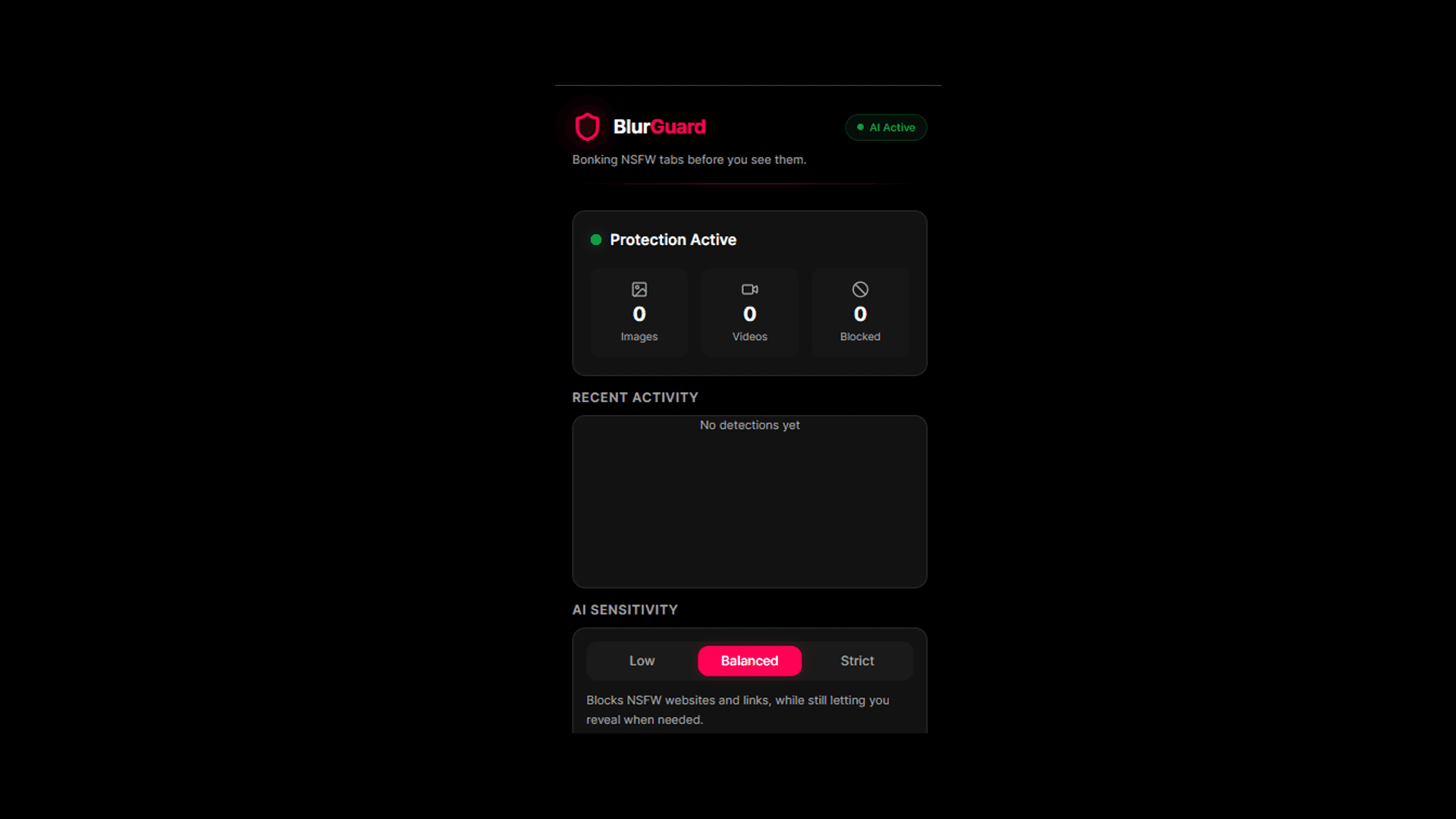
- Live popup dashboard with real-time counters and CSV/JSON export
- Video frame sampling with IntersectionObserver lifecycle hooks
- Per-domain allowlist with one-tap disable
Deliverables
- Chrome MV3 extension built with Vite 7 + custom Rollup multi-entry config
- Four isolated extension contexts with a fully-typed discriminated-union message bus (Popup, Background, Offscreen, Content Script)
- Ephemeral offscreen document for GPU inference — created on-demand, torn down after 30s idle to release ~150–250 MB WebGL/tensor memory
- LRU verdict cache (500 URLs) caching raw MobileNet scores — re-derives verdict on sensitivity change without re-running inference
- Viewport-priority queue (100-item max, deduplicated) with serial GPU serialization via Promise chain to prevent WebGL context thrashing
- Build-time cloud backend flag (__CLOUD_ENABLED__=false) dead-code-eliminates Sightengine v1.1 integration from v1 bundle
- 62 Vitest tests covering queue, cache, allowlist, and round-trip message bus
- React 19 + Tailwind CSS 4 + shadcn/ui popup with detection feed, confidence scores, and domain breakdown
The Outcome
BlurGuard ships at 1.0.0 production quality with the full detection pipeline working end-to-end: DOM scan on load, MutationObserver for injected content, video frame sampling at 4-second intervals, viewport-priority queueing, GPU inference, overlay injection, and reveal-on-click. Steady-state inference runs at ~80ms per image; cache hits resolve at ~3ms. The popup dashboard shows real-time classification counts, a timestamped detection feed with confidence scores, and CSV/JSON export. Privacy is structural: the offscreen document fetches images as chrome-extension:// origin with credentials omitted — no session cookies forwarded, no URLs or pixel data leave the device.
Results
~80msSteady-state inference per image
4Isolated extension contexts (typed bus)
62Vitest tests (queue, cache, messaging)
0 bytesData transmitted to external servers
Built with
Chrome MV3TypeScript 5.8React 19TensorFlow.js 4.22NSFW.js 4.3Tailwind CSS 4Vite 7Vitestshadcn/ui