AKSHAR
Mobile App — Health & Productivity2026Live
Dawnwell
An offline-first habit tracker for daily rituals — syncs across devices without ever making you wait.
The Challenge
Habit tracking only works if the app is frictionless at 6 AM. That means it cannot show a spinner on open, cannot lose a check-in to a network error, and cannot overwrite a change made on a second device without warning. Those three constraints — instant open, offline writes, multi-device consistency — pull in different directions. A cloud-first architecture solves sync but requires a network. Optimistic UI solves latency but silently loses conflicts. The design had to make all three work together without reaching for a library (like CRDTs) that was more complex than a single-user sync problem needed.
The Approach
SQLite is the source of truth, not the server. The app reads from the local database on open — no network call, no loading state, no blank screen. Writes go to SQLite first; the UI updates optimistically before anything reaches Supabase. The sync engine runs in the background: push local changes before pulling remote ones, so edits never get overwritten by a pull that races ahead. Merge logic is deterministic across six rules covering every conflict case — last-write wins on timestamp, with all conflicts logged rather than silently discarded. Device-local fields (notification permission IDs, local-only settings) are marked SYNC-EXCLUDE at the TypeScript level, which enforces they never reach the network schema. Animations run on the native thread via Reanimated 4 JSI worklets, keeping the UI fluid even while Drizzle runs heavier relational queries on the JS thread.
What was built
- Offline-first SQLite data layer with Drizzle ORM schema
- Custom Last-Write-Wins sync engine with 6-rule merge logic
- Ritual-grouped check-in UI (morning, focus, evening, custom)
- Native-thread animations via Reanimated 4 worklets
- Supabase auth and Postgres backend with Row Level Security
- Heatmap chart for streak and consistency visualisation
Deliverables
- React Native 0.85 (New Architecture) app shipped to both iOS App Store and Google Play as a production release
- Expo 56 + Expo Router v4 with typed file-based navigation and deep-link support across all screens
- SQLite source of truth via expo-sqlite + Drizzle ORM — schema changes error at compile-time, not at runtime on a user's device
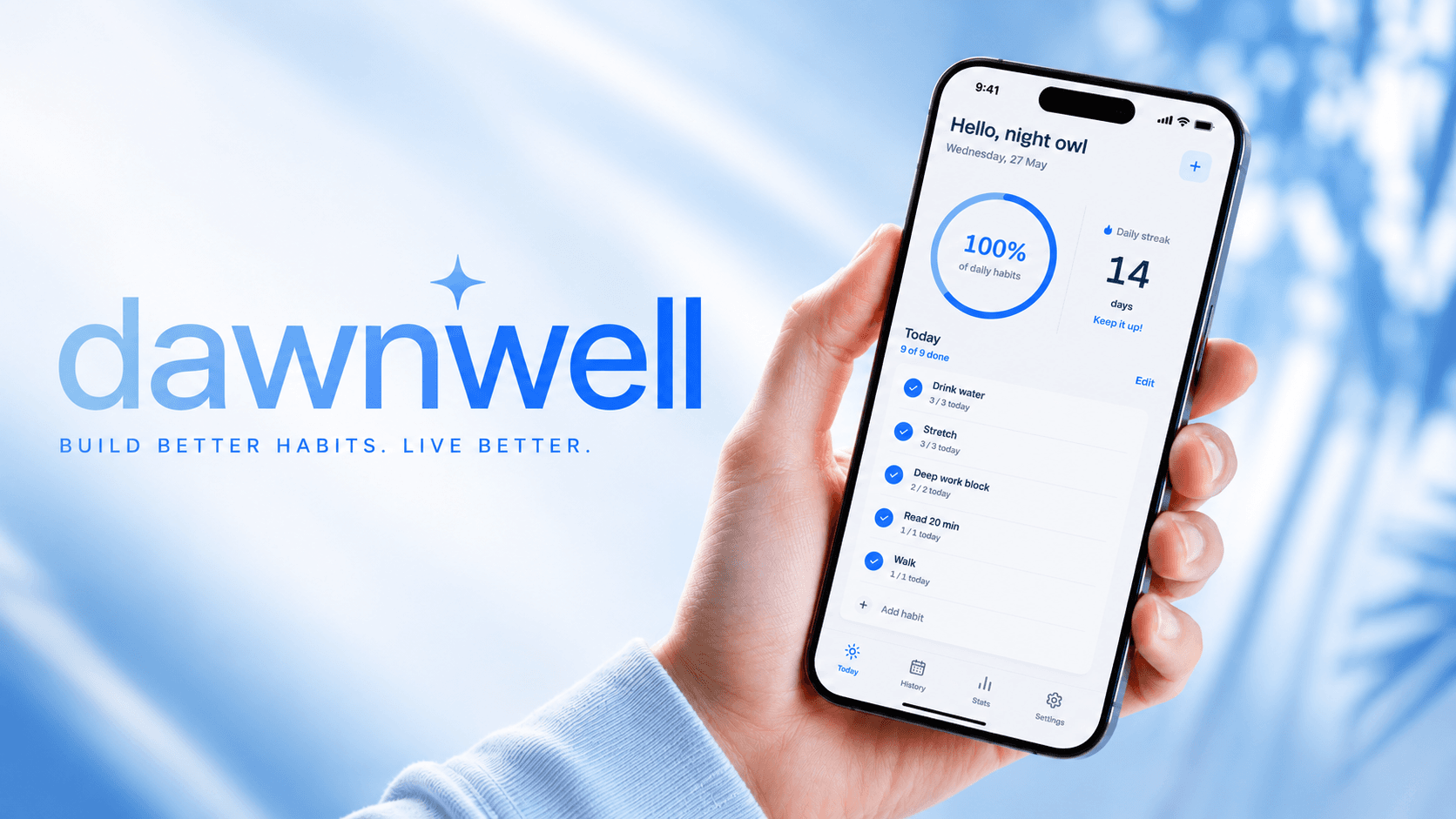
- Habit check-in UI grouped by time of day (morning, focus, evening, custom) — opening the app feels like a ritual, not a task list
- Streak heatmap chart for long-range consistency visualisation, styled after GitHub's contribution graph
- Bottom-sheet forms for habit creation and editing — no full-screen modals, no navigation stack push
- Optimistic write pattern: SQLite write + UI update fires before any network sync cycle runs — zero perceived latency on check-in
- Custom LWW sync engine: push-before-pull ordering with 5-second debounce on rapid edits, all conflicts logged never silently discarded
- Type-level sync boundaries: SYNC-EXCLUDE marker prevents device-local fields (notification IDs, local settings) from ever reaching the network schema
- Supabase auth + Postgres backend with RLS scoped to auth.uid() — cross-user data exposure is impossible at the query level
- Zustand (app state) + React Query 5 (server state) + react-native-mmkv (token/settings KV) + Reanimated 4 JSI worklets with reduce-motion support and haptic feedback throughout
The Outcome
Shipped solo to both the iOS App Store and Google Play as a production app. The check-in flow opens without network dependency — habit lists render from SQLite before any sync cycle runs. The LWW engine handles all multi-device conflict cases deterministically with no silent data loss. The design system (cool deep-blue palette, bottom-sheet forms, reduce-motion support, haptic feedback) was built as a custom token layer in code, not in a design file — so every component is consistent and portable. The architecture proved that a solo engineer can ship a production mobile app with real sync, real design, and real distribution without over-engineering the solution.
Results
2Platforms shipped (iOS + Android)
6Deterministic sync merge rules
0JS thread animation frames dropped
0Network calls needed to open the app
Built with
React Native 0.85Expo 56Expo Router v4TypeScriptSQLite + Drizzle ORMZustandReact Query 5Reanimated 4SupabaseMMKV


