AKSHAR
Mobile App — Privacy & Security2026Open Source
Defendra
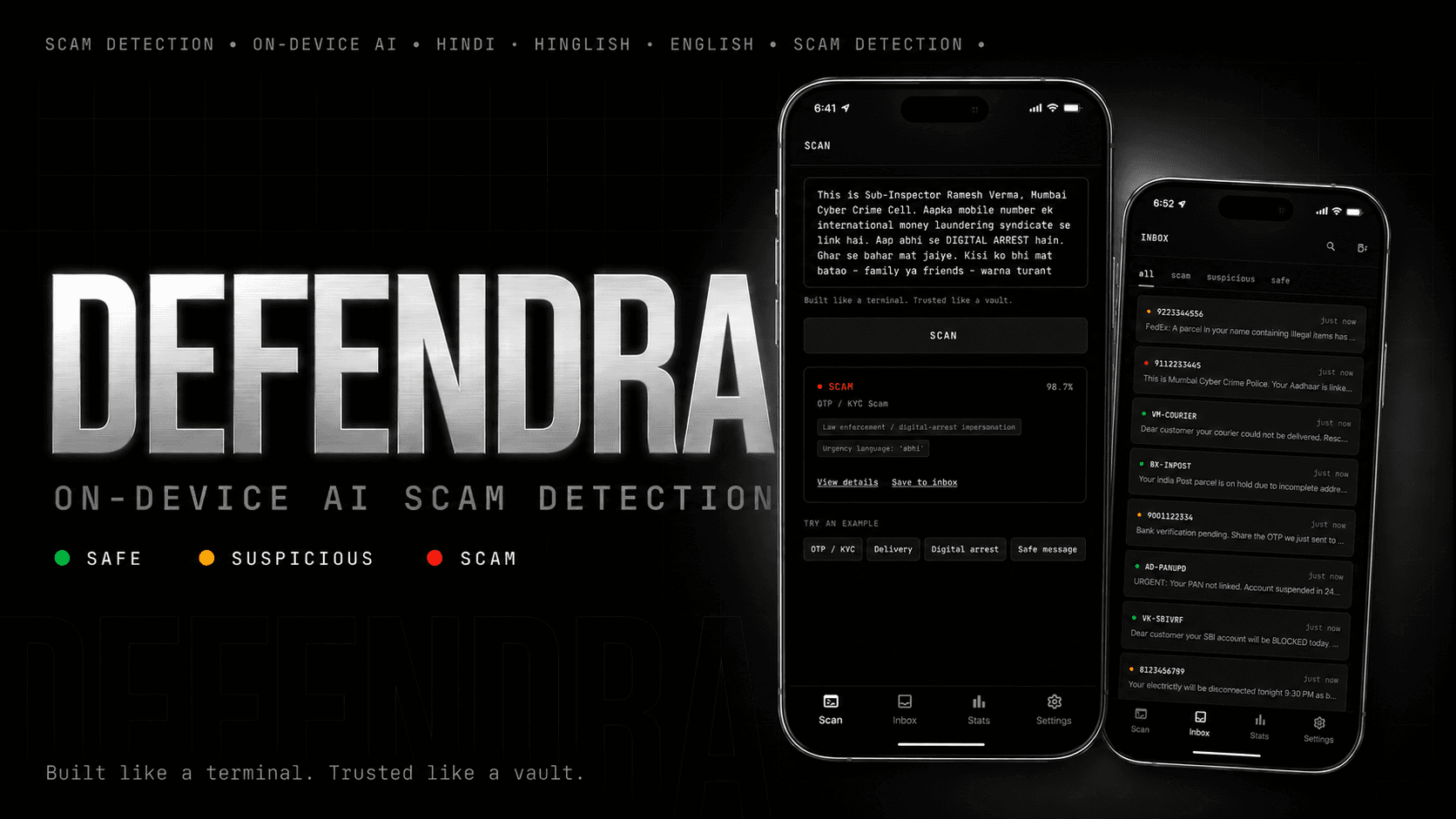
An on-device SMS scam classifier for Android — no server, no data egress, no guesswork.
The Challenge
India's SMS fraud is structural. Blocklists get rotated faster than they can be maintained. Carrier-level filters miss content-based tricks — bank impersonation, OTP harvesting, lottery lures — that change wording but not intent. Cloud classifiers work, but they require sending every private message to a third-party server, which is the wrong trade-off for a privacy tool. The model also had to handle India's SMS reality: code-mixed Hindi-English, regional transliterations, and scam templates that borrow legitimacy from real bank and telecom language.
The Approach
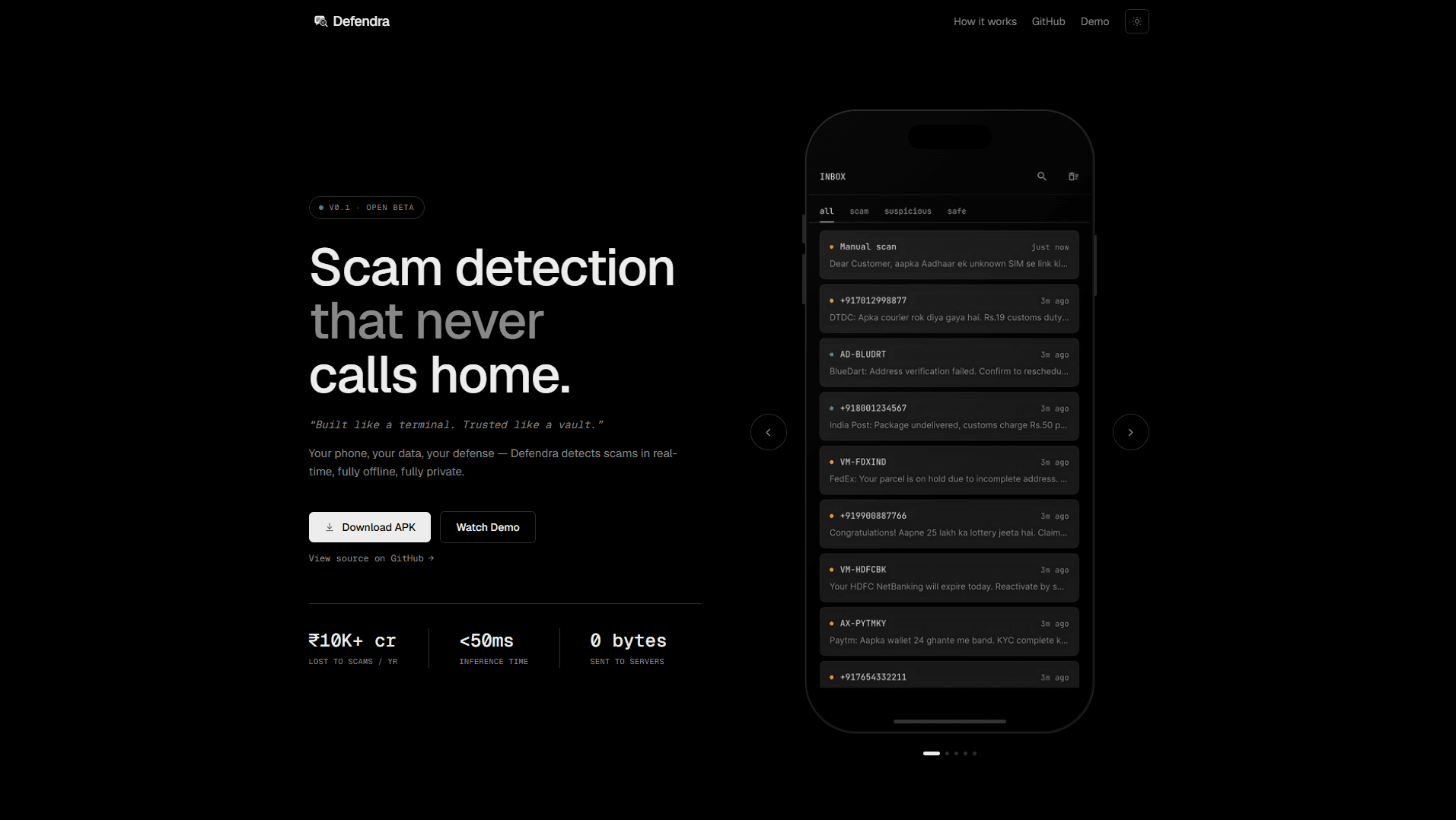
The entire inference pipeline runs on-device. A fine-tuned DistilBERT-base-multilingual model handles the language-understanding layer; a parallel regex rule engine catches known scam templates and contributes a signal score. Classification fires only when both the ML probability (p_scam > 0.85) and at least one regex signal agree — reducing false positives without softening the classifier on clear scams. Verdicts are explainable: the UI surfaces the specific regex patterns that contributed, so users understand why a message was flagged. The app holds zero network permissions; there is no HTTP client, no telemetry, and no analytics — by construction, not by configuration.
What was built
- On-device ML inference pipeline (LiteRT + DistilBERT)
- Real-time SMS interception via Kotlin BroadcastReceiver
- Regex rule engine for signal-augmented classification
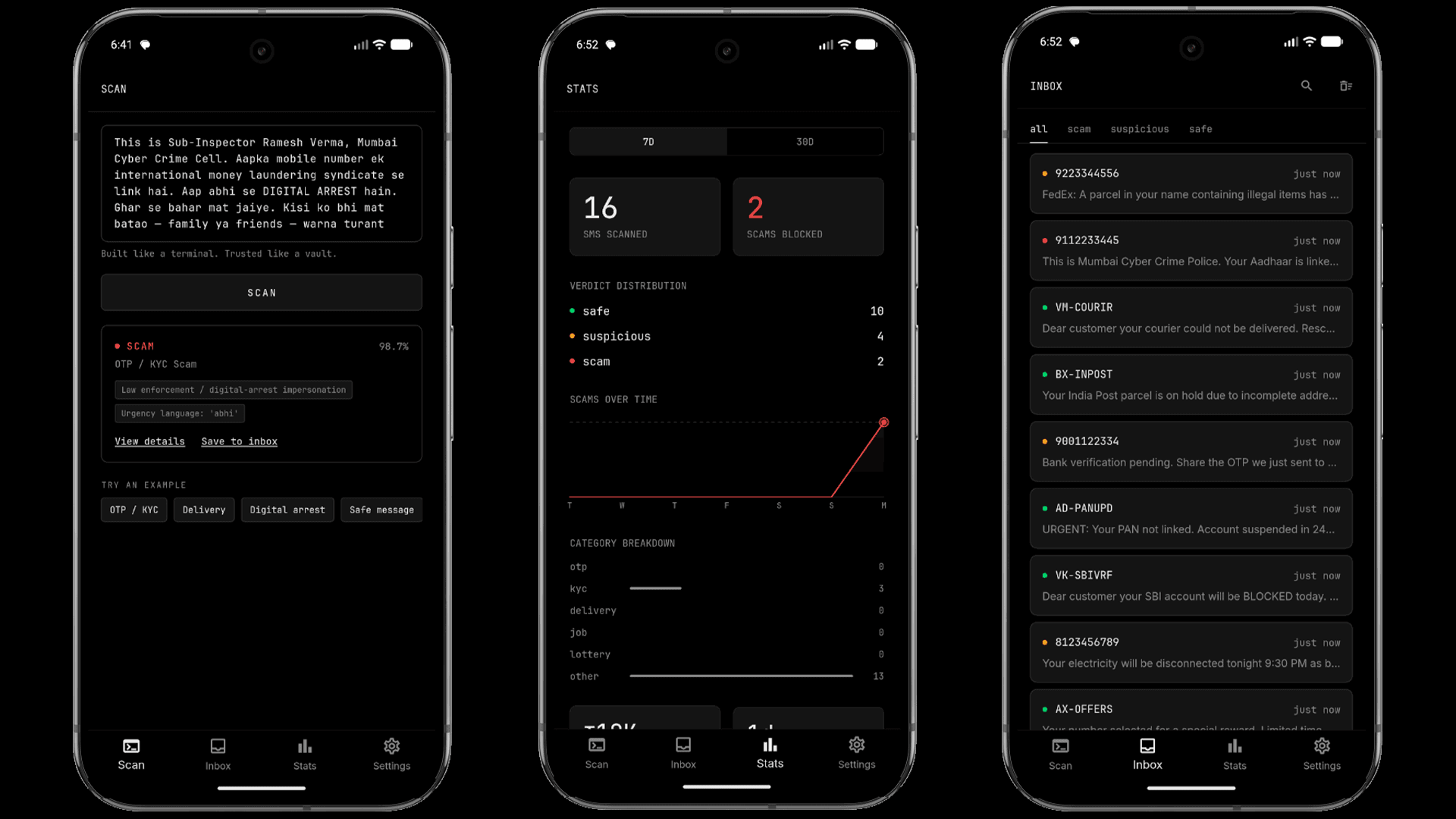
- Explainable verdict UI surfacing specific scam signals
- Manual inbox scanner for retrospective analysis
Deliverables
- Flutter 3.44 Android app with zero network permissions — no HTTP client, no analytics, no data egress by construction, not by configuration
- Fine-tuned DistilBERT-base-multilingual model (~540 MB float32) bundled as LiteRT asset, running inference entirely on-device with no network call per classification
- Kotlin BroadcastReceiver intercepting incoming SMS before the notification surfaces — verdict fires before the user taps
- Three-tier verdict system: SCAM / SUSPICIOUS / SAFE with distinct UI treatments and per-tier notification badge behaviour
- Compound decision logic: p_scam > 0.85 AND regex signal required for a SCAM verdict — prevents high false-positive rate on ambiguous messages
- Parallel regex rule engine covering bank impersonation, OTP harvesting, lottery lures, and UPI fraud templates as a signal layer alongside ML
- Explainable verdict screen listing the specific regex patterns behind each judgment in plain language, not raw scores
- Manual inbox scanner for retrospective batch analysis of existing messages
- Riverpod state management with Hive local storage for verdict history and user preferences, persisted across app restarts
- APK distribution via F-Droid — SMS READ/RECEIVE permissions block Play Store listing by policy; targeting privacy-conscious users deliberately
The Outcome
Defendra ships as an Android app with a working real-time detection pipeline and zero network egress. The model, trained on ~2,300 examples (~87% safe, ~13% scam), runs inference entirely on-device via LiteRT. The BroadcastReceiver catches and classifies incoming SMS before the notification surfaces. The manual scanner lets users retrospectively audit their inbox. Because SMS permissions restrict Play Store distribution, the APK is distributed via F-Droid — keeping it in the hands of privacy-conscious users who chose the trade-off deliberately.
Results
0Network calls per classification
~2,300Training examples (multilingual)
0.85Scam probability threshold
0 bytesData sent to third-party servers
Built with
Flutter 3.44DartLiteRTDistilBERT (multilingual)RiverpodHiveKotlinAndroid